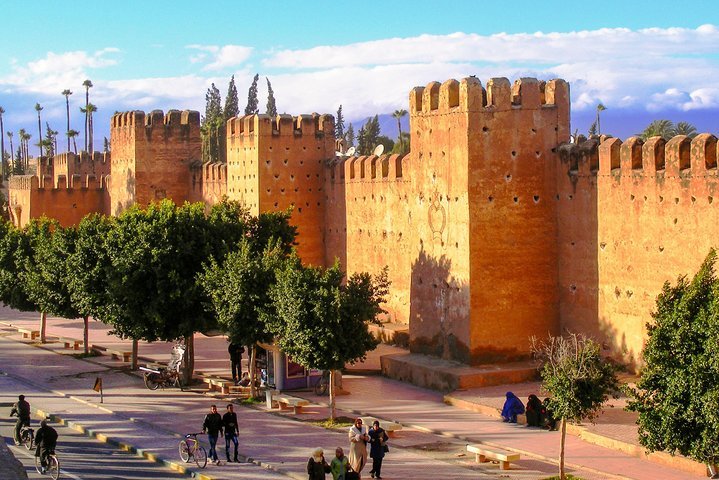
A road trip along Morocco’s Atlantic coast from Agadir to Tangier covers roughly 900 kilometres and works best over ten days to two weeks, with stops in Essaouira, the lagoon at Oualidia or the old port of El Jadida, Casablanca, Rabat and Asilah before you reach the Strait of Gibraltar. Motorways cover much of the distance, so the driving itself is manageable; the real reward lies in the slower coastal roads, the fishing harbours and the very different personalities of each city. This guide breaks the journey into stages and shares practical driving advice for the route.
I often recommend this trip to travellers who want to see a side of Morocco beyond the desert and the imperial cities. The coast offers fresh seafood, cooler summer temperatures, surf breaks, Portuguese fortresses and medinas washed in white and blue. It also connects neatly with the train network, so you can adapt the route if you prefer not to drive every stage.
Route overview
| Stage | Route | Suggested stay |
|---|---|---|
| 1 | Agadir and the Souss coast | 2 nights |
| 2 | Agadir to Essaouira | 2 nights |
| 3 | Essaouira to Oualidia or El Jadida | 1–2 nights |
| 4 | On to Casablanca | 1 night |
| 5 | Casablanca to Rabat | 2 nights |
| 6 | Rabat to Asilah | 1–2 nights |
| 7 | Asilah to Tangier | 2 nights |
You can, of course, drive the route in reverse, starting in Tangier after a ferry crossing from Spain. Distances and road times are approximate and depend on traffic, weather and how often you stop.
Stage 1: Agadir and the Souss coast
Agadir makes an easy starting point, with an international airport, a long sandy beach and a mild climate year round. Rebuilt after the earthquake of 1960, it is a modern city rather than a historic one, but it has its own charm: the hilltop ruins of the old kasbah, the busy fishing port and the vast Souk El Had market. Our guide to things to do in Agadir covers the highlights.
Before heading north, spend a day on the coast just above the city. The surf villages of Taghazout and Tamraght have a laid-back atmosphere, and the road north passes cliffs, argan trees and small beaches. If you have time, the fishing village of Imsouane is a beautiful detour with one of the longest waves in Morocco.
Stage 2: Agadir to Essaouira
The coast road from Agadir to Essaouira is one of the most scenic drives in the country. It winds above the ocean through argan country, where goats sometimes climb into the trees, and passes quiet beaches and small villages. Allow several hours with stops.
Essaouira is a highlight of any coastal trip. Its walled medina, laid out in the eighteenth century and now a UNESCO World Heritage Site, has white houses with blue shutters, art galleries, woodworking workshops and a lively fishing harbour where blue boats come and go. The ramparts, the skala, offer superb views over the sea. The town is known for its steady trade winds, which keep summer temperatures pleasant and attract kitesurfers. If you plan to get on the water, our article on Essaouira’s wind and the best time for kitesurfing explains the seasons.
Stage 3: Oualidia or El Jadida
North of Essaouira, the road passes the town of Safi, famous for its pottery, before reaching two very different stops.
Oualidia
Oualidia is a small, peaceful resort set around a sheltered lagoon protected from the ocean by a ridge of rock and sand. The calm water is ideal for swimming, paddling and gentle boat trips, and the lagoon is known for its oyster farms. Migrating birds also stop here, especially in autumn and spring. It is a good place to slow down for a night.
El Jadida
Further north, El Jadida is a larger town with a remarkable history. Its old quarter, the Cité Portugaise, was a fortified Portuguese settlement known as Mazagan, and it was inscribed on the UNESCO World Heritage List in 2004. The highlight is the underground cistern, a vaulted hall where a thin layer of water reflects the columns and the light from a single opening in the roof. Walk the ramparts for views over the harbour.
If you have time, stay in Oualidia and stop in El Jadida for a few hours on the way north. Both are within a short drive of each other.
Stage 4: Casablanca
Casablanca is Morocco’s largest city and its economic heart. It is busy and noisy, and driving in the centre can be stressful, so consider parking your car and getting around by tram and taxi. The city’s must-see is the Hassan II Mosque, built partly over the ocean, with a minaret that ranks among the tallest in the world. Unusually, the mosque has generally been open to non-Muslim visitors on guided tours; check current arrangements locally.
Beyond the mosque, wander the Habous quarter, admire the Art Deco buildings of the city centre and walk the Corniche at sunset. Our article on Casablanca in one day suggests a simple route.
Stage 5: Rabat
Rabat, the capital, is less than an hour from Casablanca by motorway or train. It is calmer, greener and easier to explore. Highlights include the Kasbah of the Udayas above the river mouth, the Hassan Tower and the Mausoleum of Mohammed V, the Chellah with its Roman and medieval ruins, and a gentle medina. Across the Bou Regreg river, Salé offers a more traditional atmosphere. Our guide to Rabat for first-timers explains why two days is ideal.
Stage 6: Asilah
From Rabat, the motorway heads north past Kenitra and Larache to Asilah, a small fortified town on the ocean. Its compact medina, enclosed by Portuguese ramparts, is one of the prettiest on the coast, with whitewashed houses, blue and green doors and walls painted with murals. Asilah is known for a long-running cultural festival in summer, when artists paint new murals across the medina, though dates vary from year to year.
Asilah is a place to stroll, eat fresh fish and watch the sunset from the ramparts. It also makes a quieter base than Tangier, with the city less than an hour away. If you have time, the Roman ruins of Lixus, near Larache, are worth a short detour.
Stage 7: Tangier
The journey ends in Tangier, at the meeting point of the Atlantic and the Mediterranean. The city has a long cosmopolitan history, with traces of many cultures and an international era in the twentieth century that drew writers and artists. Explore the medina and the Kasbah, take mint tea at a café overlooking the Strait, and drive west to Cap Spartel, where the lighthouse marks the north-west corner of Africa. The Caves of Hercules nearby are a popular stop.
From Tangier, you can return south quickly on the Al Boraq high-speed train, continue into the Rif mountains towards Chefchaouen, or cross the Strait to Spain. Our guide to taking the ferry between Spain and Tangier explains the ports and formalities.
Driving tips for the Atlantic coast
Roads and motorways
- Motorways: a toll motorway runs from Agadir to Marrakech and from Marrakech north towards Casablanca, Rabat and Tangier. It is the fastest way to cover long distances. Keep some cash for toll booths.
- Coastal roads: the smaller roads along the coast are slower but far more scenic. Expect villages, roundabouts, livestock and occasional roadworks.
- Night driving: I recommend avoiding driving after dark outside cities. Unlit vehicles, pedestrians and animals are hard to see.
Rules and checks
- Driving is on the right. Speed limits are enforced, and police checkpoints with radar are common, particularly at the entrance to towns. Slow down when you see them.
- Seatbelts are compulsory for all passengers.
- Carry your driving licence, passport, car rental documents and insurance papers at all times. Check whether you need an international driving permit for your nationality.
- At roundabouts, priority rules can vary in practice, so approach carefully and watch other drivers.
In towns and cities
- Driving in Casablanca, Rabat and Tangier can be stressful. Consider leaving the car at your accommodation and using taxis or the tram.
- Many medinas are car-free. Park outside the walls and walk in.
- Informal parking attendants in high-visibility vests are common. They watch your car and expect a small tip when you leave.
Fuel and breaks
- Petrol stations are frequent along the motorways and in towns, but fill up before long rural stretches.
- Motorway service areas usually have cafés, toilets and prayer rooms, and make good rest stops.
When to go
The Atlantic coast is pleasant for much of the year. Spring and autumn offer warm days and fewer crowds. Summer is cooler than inland Morocco but busy with domestic holidaymakers, especially in July and August. Winter is mild in the south around Agadir, while the north can be rainy and windy. Our guide to the best time to visit Morocco by region has more detail.
Frequently asked questions
Do I need a car for this trip?
Not necessarily. Coaches run by CTM and Supratours link the coastal towns, and ONCF trains connect Casablanca, Rabat, Asilah and Tangier. A car gives you more freedom for small places like Oualidia and the coast road from Agadir to Essaouira.
Is it safe to drive in Morocco?
Many visitors drive in Morocco without problems. Driving styles can be assertive, so stay alert, avoid night driving in rural areas and follow speed limits carefully.
Can I do the route in a week?
It is possible, but rushed. With seven days, choose a few highlights, such as Essaouira, Rabat and Asilah, and use the motorway or train for longer stretches.
Plan your trip
Each stop on this coast has its own guide in our library. Start with the Agadir travel guide and the Essaouira travel guide for the southern stretch, then continue with the Casablanca, Rabat and Tangier guides as you head north. You can browse them all in the Morocco travel library.
This article was written with the assistance of artificial intelligence, and was reviewed and edited by the Enjoy Agadir Trip team. How we write and check our guides