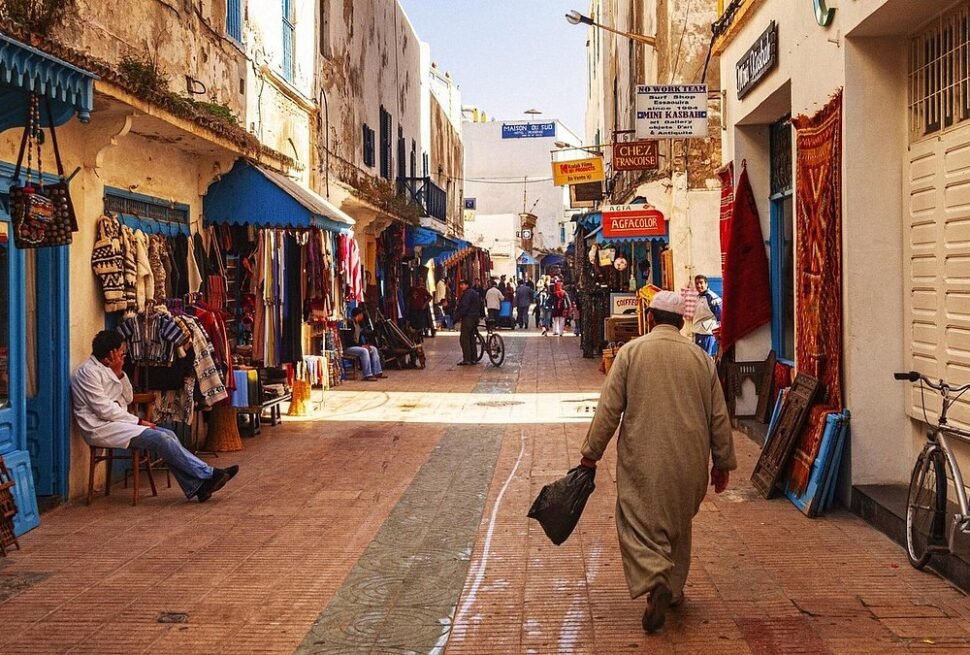
One well-planned day in Casablanca is enough for its essentials. Start with a guided tour of the Hassan II Mosque, walk through the old medina, admire the Art Deco buildings of the city centre, browse the Habous quarter and finish with sunset on the Corniche. Distances are bigger than in Morocco’s medina cities, so short taxi or tram hops between areas will save your feet and your time.
Many travellers pass through Casablanca only for its airport or train stations. That is a shame, because Morocco’s largest city has a character of its own: modern, commercial, busy with traffic and full of twentieth-century architecture you won’t find elsewhere in the country. Here is how our team would spend a single day.
Getting your bearings
Casablanca spreads along the Atlantic coast, and the parts most visitors want to see fall into a few areas:
- The seafront by the mosque. The Hassan II Mosque stands on a platform over the ocean, west of the old medina.
- The old medina. A compact walled quarter near the port.
- The city centre. Grand boulevards and squares lined with Art Deco and Mauresque buildings, mostly built during the French protectorate.
- The Habous quarter. A planned “new medina” a little to the south-east of the centre.
- The Corniche at Ain Diab. The seafront promenade further west, with beaches and ocean views.
The city’s tram network links several of these areas, and petit taxis are plentiful. Ask for the meter or agree the fare before you set off.
Morning: the Hassan II Mosque
The Hassan II Mosque is the main reason many visitors stop in Casablanca. Completed in the early 1990s, it is one of the largest mosques in the world, and its minaret is among the tallest anywhere. Part of the building stands over the sea, and on a clear day the combination of ocean, stone and sky is striking.
Unusually for Morocco, non-Muslim visitors can go inside on a guided tour. These tours usually run at set times on most days, though the schedule changes around prayer times, Fridays and religious holidays. Check the current arrangements before you go and arrive early, as groups fill up.
Inside, guides explain the craftsmanship that went into the building: carved cedar ceilings, intricate plasterwork, marble and zellige tilework, much of it made by artisans from across Morocco. Some tours also include the lower level with its ablution fountains and hammam area.
A few pointers for the visit:
- Dress modestly, with shoulders and knees covered. Women may want to bring a light scarf, though it is not always required on tours.
- You will remove your shoes inside. A small bag to carry them is handy.
- Take time to walk around the outside of the mosque and along the esplanade, which is free to wander and offers fine views of the minaret and the sea.
Late morning: the old medina
From the mosque, it is a walk of around twenty to thirty minutes along the seafront, or a short taxi ride, to the old medina. It is much smaller and less monumental than the medinas of Fes or Marrakech, and that is part of its appeal. This is an everyday neighbourhood, with small shops, workshops, laundry hanging between buildings and residents going about their business.
Look out for:
- The Sqala. An eighteenth-century bastion on the medina’s seaward edge, with cannons facing the ocean.
- The gates and walls. Parts of the old ramparts survive around the medina’s edges, including Bab Marrakech near the centre.
- Everyday commerce. Stalls selling household goods, clothes and snacks give a feel for local life rather than a tourist souk.
The medina is generally fine to explore by day. Keep an eye on your belongings in busy lanes, as in any big city.
Lunch and the city centre’s Art Deco
Walk out of the medina towards the city centre and look up. Casablanca grew rapidly in the early twentieth century, and architects of the period left an extraordinary collection of Art Deco, Neo-Mauresque and modernist buildings. Some are beautifully restored, others are faded, and spotting the details is half the fun: carved balconies, curved corners, geometric ironwork and Moroccan motifs blended with European styles.
A short Art Deco walk
- Boulevard Mohammed V. One of the city’s grand old avenues, lined with arcades and decorated facades. The tram now runs along part of it.
- The Central Market. A covered market from the protectorate period, with a fine entrance and stalls of fish, flowers, fruit and olives. A good place for a snack and a look at daily life.
- Place Mohammed V. A large square framed by grand administrative buildings, including the law courts, the post office and the former prefecture with its clock tower. Together they show the Neo-Mauresque style at its most confident.
- The Arab League Park. A long, leafy park close by, pleasant for a break in the shade.
- The former Sacré-Cœur Cathedral. A striking white church building from the early twentieth century, no longer used for worship. It is now used for cultural events and exhibitions, and access can vary.
If you are keen on architecture, local heritage associations sometimes organise walks or open-days focused on the city’s twentieth-century buildings. Check locally for anything running during your visit.
Afternoon: the Habous quarter
Take a taxi or tram towards the Habous quarter, also called the New Medina. It was built in the 1920s and 1930s as a planned neighbourhood that reinterpreted traditional Moroccan architecture. It has arcaded streets, small squares, whitewashed walls and neat lanes, and it feels calmer and more orderly than an old medina.
The Habous is a pleasant place to browse. It is known for its booksellers, olive sellers, traditional pastries and shops selling brassware, leather and religious items. Nearby, the Mahkama du Pacha, a former court and administrative building, is renowned for its rich interior decoration, though visitor access can be limited. The outer walls of the Royal Palace lie close to the Habous. The palace itself is not open to the public, but its gates are often admired from outside.
If you buy anything, bargain gently and with a smile. Our guide to bargaining in Moroccan souks explains how it usually works.
Evening: sunset on the Corniche
End the day out west on the Corniche at Ain Diab. A long seafront promenade runs past beaches, with joggers, families and couples coming out as the light fades over the Atlantic. It is a good place to see the city relax.
At low tide, you can see the small shrine of Sidi Abderrahman sitting on a rocky outcrop just offshore. It is a place of local pilgrimage and popular belief. It is worth admiring from the shore, but it is not really a tourist attraction to wander into.
How to fit it all in
Our team suggests this order for a single day:
| Time of day | Area | Getting there |
|---|---|---|
| Morning | Hassan II Mosque tour and esplanade | Taxi from your accommodation or station |
| Late morning | Old medina and the Sqala | Walk along the seafront or a short taxi |
| Lunch and early afternoon | City centre Art Deco walk | On foot from the medina |
| Mid-afternoon | Habous quarter | Taxi or tram |
| Sunset | Corniche at Ain Diab | Taxi or tram |
If your time is shorter, prioritise the mosque and the city centre, as both are close to the main stations. If you are arriving or leaving by train, our Morocco train travel guide explains the main stations, the ONCF network and the high-speed Al Boraq line to the north.
Practical tips
- Traffic is heavy. Allow extra time for taxis at rush hour, and cross roads with care.
- Dress for a modern city. Casablanca is more relaxed than many Moroccan towns, but modest dress is still appreciated, and it is required for the mosque. See our guide on what to wear in Morocco.
- Bring a layer. The coast can be breezy and cooler than inland, especially in the evening.
- Use common sense. As in any large city, keep valuables out of sight, especially in crowded areas and on public transport.
Frequently asked questions
Is Casablanca worth visiting for just one day?
Yes. A single day gives you the Hassan II Mosque, which is one of Morocco’s most impressive buildings, along with a taste of the city’s architecture and modern life. Many travellers find it a useful contrast with the older medina cities.
Can non-Muslims enter the Hassan II Mosque?
Yes, on guided tours. It is one of the few mosques in Morocco open to non-Muslim visitors in this way. Tour schedules vary, so check before you go.
How do I get around Casablanca?
Petit taxis and the tram are the most practical options for visitors. The main sights are spread out, so a mix of walking and short rides works best.
Where can I go next from Casablanca?
Rabat is a short train ride up the coast, and our first-timer’s guide to Rabat is a good starting point. Marrakech, Fes and Tangier are also well connected by rail.
Plan your trip
Our Casablanca travel guide goes deeper into the city’s neighbourhoods, architecture, food and practicalities, with longer itineraries for travellers who stay more than a day. If you are heading up the coast, our Rabat travel guide makes a natural companion, and the full Morocco travel library covers the rest of the country.
This article was written with the assistance of artificial intelligence, and was reviewed and edited by the Enjoy Agadir Trip team. How we write and check our guides